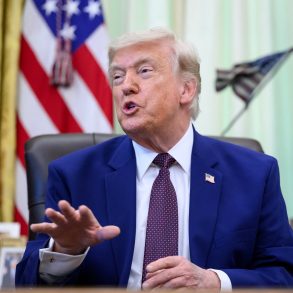

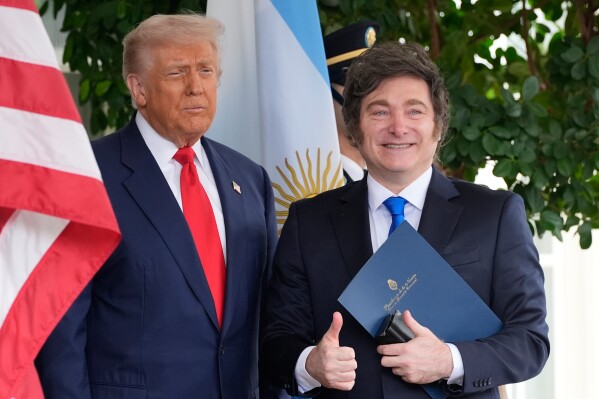
WASHINGTON — In a bold move that blurs the lines between foreign aid and election interference, President Donald Trump warned on Tuesday that the United States would withdraw its $20 billion financial lifeline to Argentina if President Javier Milei’s party fails to win upcoming midterm elections. The statement came during a White House lunch meeting with Milei, a fellow right-wing populist who has openly modeled his leadership after Trump’s “Make America Great Again” (MAGA) slogan.
Trump’s comments mark a rare instance of a U.S. president openly tying American assistance to the outcome of another country’s democratic vote. “If he loses, we are not going to be generous with Argentina,” Trump said from the Cabinet Room. He described the aid as support for a “great philosophy” rather than a bailout, emphasizing that the U.S. won’t “waste our time” or taxpayer money on leaders who oppose Milei’s free-market reforms.
A Bromance Built on Shared Ideology
Milei, a 54-year-old economist turned president, has become one of Trump’s closest international allies. During the meeting, Milei praised Trump in Spanish, calling him a model for “freedom and prosperity” and thanking him for recognizing the “threat that socialism represents” in Latin America. Trump returned the compliments, dubbing Milei “MAGA all the way” — a twist on his own slogan to mean “Make Argentina Great Again.”
The two leaders’ friendship has already delivered tangible benefits for Argentina. Just weeks ago, after Milei’s party suffered a major loss in local elections, the Argentine peso plummeted, and investors fled the country’s bonds. Facing a crisis of confidence amid rising unemployment and inflation, Milei turned to Trump during a September meeting at the United Nations in New York.
U.S. Treasury Secretary Scott Bessent quickly announced a $20 billion deal, allowing Argentina to swap pesos for dollars. Bessent called Milei’s reforms “of systemic importance” and even revealed that the U.S. Treasury directly purchased an undisclosed amount of pesos to stabilize the currency. Markets rallied in response, giving Milei breathing room ahead of the October 26 midterms, which will test his austerity measures and could shape his 2027 reelection bid.
Domestic Backlash and “America First” Questions
The aid package has sparked outrage in the U.S., where critics argue it contradicts Trump’s “America First” agenda. Senator Elizabeth Warren (D-Mass.) attempted to block the funds in the Senate, calling it “Argentina first, not America first.” She accused Trump of rewarding a loyalist while American workers suffer from a government shutdown and mass layoffs.
Even some Republicans are uneasy. Senator Chuck Grassley (R-Iowa) highlighted how Argentina competes with U.S. soybean farmers for global exports, especially as China shifts purchases to South American suppliers amid trade tensions. “The administration should be supporting American farmers instead,” Grassley posted on social media.
Trump dismissed the concerns, claiming the aid won’t significantly impact the U.S. economy and accusing China of trying to divide the two nations. Bessent echoed this, predicting Milei’s coalition would “do quite well” in the midterms and continue reforms.
Opposition Fires Back in Argentina
Back in Buenos Aires, the meeting fueled political fireworks. Cristina Fernández de Kirchner, a former president and leader of the left-leaning Peronist opposition, blasted Trump on social media: “Trump to Milei: ‘Our agreements are subject to whoever wins election.’ Argentines … you know what to do!” Despite serving a corruption sentence under house arrest, Kirchner remains a powerful voice in Peronism, a populist movement focused on labor rights that has dominated Argentine politics for decades.
Milei blamed his country’s woes on “the opposition’s attacks” and past left-wing policies, which he says caused decades of economic mismanagement. Argentina, the IMF’s largest debtor, has defaulted on debts nine times and recently received $20 billion from the IMF in April — plus an earlier $40 billion loan. Experts like Brad Setser, a former Treasury official, worry that Argentina missed early IMF targets and may struggle to repay the new U.S. funds.
Broader Agenda: AI and Regional Ties
Beyond finances, the leaders discussed expanding the Stargate project — a massive AI data center network backed by OpenAI, Oracle, and SoftBank. Argentina could host Latin America’s first site, an initiative Trump has championed.
Milei also attended a White House ceremony honoring Charlie Kirk, a right-wing activist killed last month, underscoring their shared conservative networks.
Historical Echoes of U.S. Intervention
Trump’s approach fits a pattern of endorsing like-minded leaders abroad, including Hungary’s Viktor Orban and Poland’s Karol Nawrocki. Secretary of State Marco Rubio has prioritized Latin America, countering what he sees as Biden-era neglect.
Historically, the U.S. has intervened in the region through bailouts, IMF loans, and even CIA-backed coups during the Cold War. Supporters argue such aid promotes global stability, but critics say it risks entangling America in foreign politics at taxpayers’ expense.
As Argentina heads to the polls, the $20 billion hangs in the balance — a high-stakes gamble on Milei’s survival and Trump’s vision for a MAGA-aligned hemisphere.