
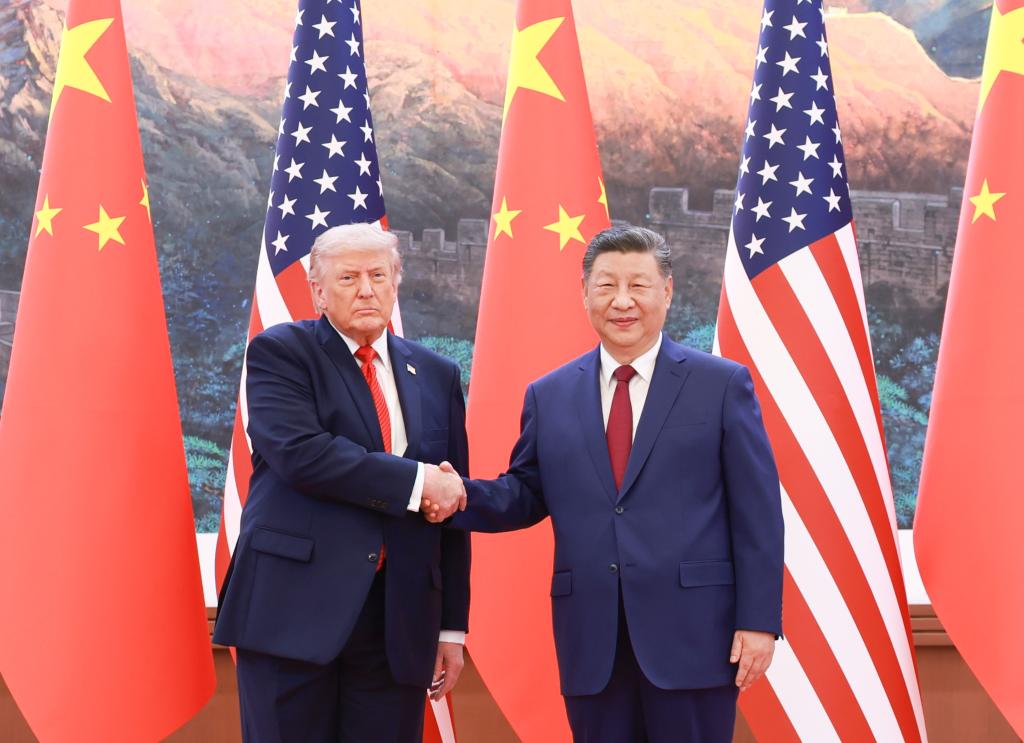
U.S. President Donald Trump wrapped up a two-day summit with Chinese President Xi Jinping in Beijing, describing the meetings as “very successful” and claiming major trade breakthroughs. However, neither side has released concrete details or official confirmations of new agreements.
Trump arrived in Beijing accompanied by a high-level business delegation that included CEOs from key sectors such as agriculture, aviation, electric vehicles, and artificial intelligence. Among the prominent figures were Tesla’s Elon Musk and Nvidia’s Jensen Huang, highlighting the importance of technology and economic issues during the visit.
The summit featured warm public gestures and symbolic events. Trump was greeted with an honor guard, attended a state banquet, and was even invited into the exclusive leadership compound of the Chinese Communist Party. Trump said the talks went well and invited Xi to visit the White House in September. China’s Foreign Minister Wang Yi later confirmed that Xi would make the trip this autumn. Xi described the visit as “historic and landmark.”
Despite the positive tone, few tangible results have been announced. Trump told reporters aboard Air Force One that China had agreed to purchase 200 Boeing jets, with a possible commitment for 750 more. He also said American farmers could expect China to buy “billions of dollars” worth of soybeans. The BBC has reached out to Boeing for comment, but Chinese officials have not confirmed any of these purchases.
Chinese Foreign Ministry spokesperson Guo Jiakun emphasized that U.S.-China economic relations should be based on “mutual benefit and win-win cooperation.” He said both countries should focus on implementing the consensus reached by the two leaders to stabilize trade ties.
Trade Truce and Future Mechanisms
The two sides are still operating under a tariff truce agreed to last October. That agreement paused steep U.S. tariff increases on Chinese goods while China eased restrictions on rare earth exports. Interestingly, Trump said he and Xi did not discuss tariffs during this summit. Instead, the White House announced plans to create a new “Board of Trade” to manage the economic relationship going forward.
U.S. officials, including Treasury Secretary Scott Bessent, expressed hope for progress on investment mechanisms, but cautioned that much work remains before any agreements take effect.
Focus on Technology and Business
The presence of Musk and Huang drew attention to technology issues. Tesla depends heavily on its Shanghai factory and Chinese sales, while Nvidia is eager to resume selling advanced chips to China, which are currently restricted by U.S. export controls aimed at limiting China’s AI capabilities.
Trump mentioned discussions about establishing “guardrails” for AI cooperation, though he provided few specifics. Chinese officials continue to criticize U.S. restrictions on technology transfers while pushing for greater market access.
Agriculture and Market Access
American farmers, who suffered during previous tariff battles, are hoping for increased exports of soybeans, beef, and poultry. U.S. Trade Representative Jamieson Greer said some agricultural purchase deals had been finalized, but China’s foreign ministry only spoke in general terms about maintaining stable trade and expanding cooperation based on equality and mutual respect.
Xi told U.S. business leaders that China’s “doors will open wider” and that American companies would find “broader prospects” in the Chinese market. He called for stronger cooperation in trade, agriculture, healthcare, tourism, and law enforcement.
Taiwan Remains a Sensitive Issue
While trade dominated the agenda, Beijing linked the broader economic relationship to the Taiwan issue. China considers Taiwan part of its territory, while the U.S. supports the self-governing island as a key ally. According to Chinese readouts, Xi stressed the need for a “new positioning” in U.S.-China relations based on “constructive strategic stability.”
Overall, the summit was marked more by friendly symbolism and optimistic statements than by signed agreements. Both sides expressed hope for future progress, but analysts will be watching closely to see whether the warm words translate into real deals in the coming months.