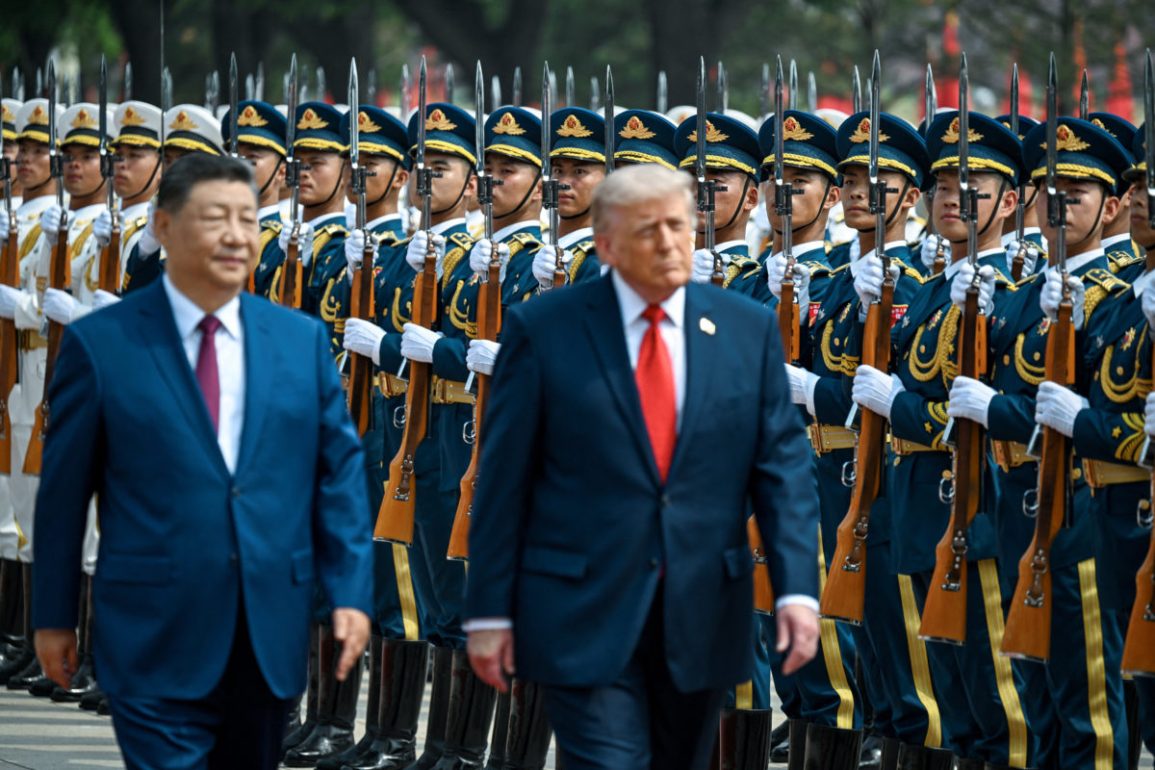
Chinese President Xi Jinping delivered a sharp warning to President Donald Trump on Thursday, saying the United States and China risk clashes or even conflict if the Taiwan issue is not managed carefully. The strong message came during a high-profile summit in Beijing, even as Trump publicly praised Xi as a great leader.
The two leaders met for about two hours at the Great Hall of the People. Their talks highlighted deep differences on several major issues, including Taiwan, the war in Iran, and ongoing trade disputes. While the visit featured impressive ceremonies and friendly public statements, it appeared unlikely to produce major breakthroughs.
During the closed-door meeting, Xi emphasized that Taiwan is the most important and sensitive issue in U.S.-China relations. According to Chinese Foreign Ministry spokesperson Mao Ning, Xi told Trump that if the issue is handled properly, the overall relationship between the two countries can remain stable. However, if not, “the two countries will have clashes and even conflicts,” putting the entire relationship at risk.
This firm stance contrasted with Trump’s warm public remarks. Before their private talks, Trump told Xi, “You’re a great leader,” and called it an honor to be his friend. He also predicted that U.S.-China relations “is going to be better than ever before.”
Xi, in his opening comments, expressed hope that the two powers could avoid conflict. He asked whether the United States and China could escape what scholars call the “Thucydides Trap” — the idea that rising powers often end up in war with established ones.
Focus on Taiwan
The Taiwan question remains one of the most dangerous flashpoints. China claims the self-ruled island as its territory, while the U.S. has long supported Taiwan’s ability to defend itself. The Trump administration has approved an $11 billion arms package for Taiwan, though delivery has not yet begun.
After the meeting, Secretary of State Marco Rubio said U.S. policy on Taiwan remains unchanged. He warned that any Chinese attempt to take the island by force would be “a terrible mistake.” Rubio noted that China often raises the issue, the U.S. restates its position, and then both sides move on to other topics.
Taiwan’s government responded positively, thanking the United States for its continued support and saying it welcomed efforts to maintain regional stability.
Other Key Topics
The leaders also discussed the ongoing war in Iran. Trump told Fox News that Xi expressed willingness to help negotiate an end to the conflict and reopen the Strait of Hormuz for oil shipments. The closure of the strait has disrupted global energy supplies and driven up prices.
Both sides agreed the strait should remain open. China, which buys large amounts of Iranian oil, showed interest in possibly purchasing more U.S. oil in the future to reduce its reliance on the Gulf region.
On trade, the White House said the two leaders explored ways to expand economic cooperation. Trump reported that Xi indicated China would buy 200 Boeing jets. Discussions also covered increased Chinese purchases of American agricultural products like soybeans and beef, as well as efforts to stop the flow of fentanyl precursors into the United States.
Xi later hosted Trump at a state banquet and took him on a tour of the Temple of Heaven. In his toast, Xi said the two countries had kept relations “generally stable” in a turbulent world. He added that China’s goal of national rejuvenation and Trump’s “Make America Great Again” agenda “can go hand in hand.”
Trump described the day as “fantastic” and said the discussions were “all good for the United States and China.” He announced that Xi would make a return visit to the White House on September 24.
Pageantry Over Progress?
The summit featured a grand welcome with military honors, national anthems, and schoolchildren waving flags. However, many observers noted that the visit seemed heavier on symbolism than on concrete agreements. Both sides continue to seek wins on trade while managing serious security tensions, especially over Taiwan.
The coming months will show whether the friendly public tone can lead to real progress or if underlying disagreements — particularly on Taiwan — will create new friction between the world’s two largest economies.