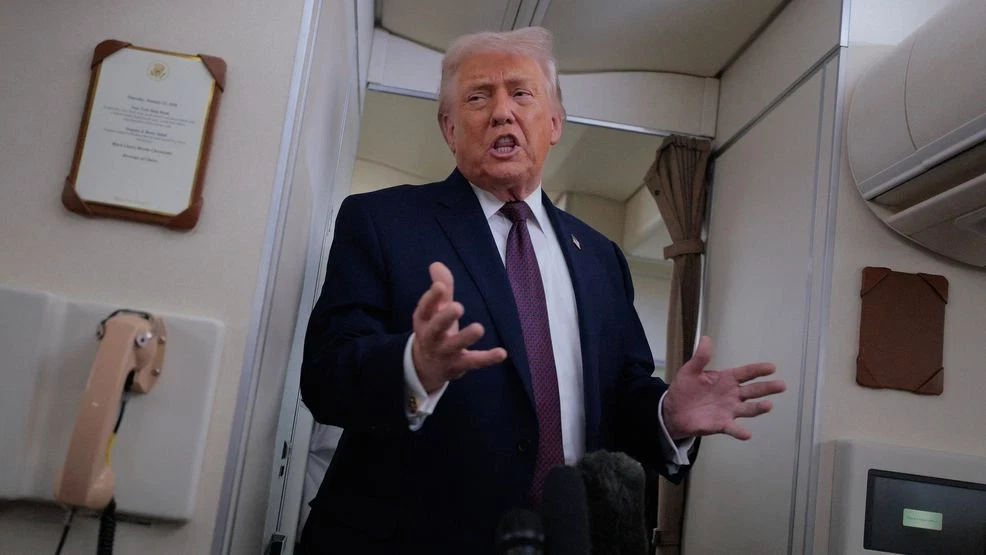
President Donald Trump’s latest escalation in trade rhetoric has thrust U.S.-Canada relations into renewed uncertainty, as he issued a blunt threat to impose 100% tariffs on all Canadian imports should Ottawa permit Canada to function as a “drop off port” or conduit for Chinese goods seeking to enter the American market while circumventing U.S. trade barriers.
In a series of forceful posts on Truth Social dated January 24, 2026, Trump addressed Canadian Prime Minister Mark Carney directly, deliberately referring to him as “Governor Carney”—a pointed rhetorical choice that revives his earlier campaign-era remarks diminishing Canada’s sovereignty and even hinting at annexation fantasies. “If Governor Carney thinks he is going to make Canada a ‘drop off port’ for China to send goods and products into the United States, he is sorely mistaken,” Trump wrote. He escalated the language further, warning that Beijing would “eat Canada alive” and “completely devour it,” including the destruction of its businesses, erosion of its social fabric, and fundamental alteration of its way of life.
Trump left little room for negotiation in his follow-up statement: “If Canada makes a deal with China, it will immediately be hit with a 100% tariff against all Canadian goods and products coming into the U.S.A.” He closed by asserting that global stability hinges on preventing Chinese dominance over its northern neighbor, declaring emphatically, “The last thing the World needs is to have China take over Canada. It’s NOT going to happen, or even come close to happening!”
The warning arrives amid visibly deteriorating personal and diplomatic relations between Trump and Carney. Tensions reached a public boiling point during the World Economic Forum in Davos, Switzerland, earlier in January 2026. In his address, Carney—carefully avoiding any direct mention of Trump—offered a sobering diagnosis of the contemporary international system. He described an “era of great-power rivalry” in which the long-standing “rules-based order” is steadily unraveling, enabling powerful states to act unilaterally while weaker ones endure the consequences. Carney urged middle powers such as Canada to act collectively and help construct a new international framework that reflects their values, cautioning that “if you are not at the table, you are on the menu.”
Trump interpreted the speech as a personal slight. In his own Davos remarks, he accused Carney of ingratitude, claiming Canada receives substantial “freebies” from the United States and insisting that “Canada lives because of the United States.” He later used Truth Social to issue what amounted to a symbolic diplomatic snub, publishing an “open letter” revoking Canada’s invitation to join the U.S.-led Board of Peace tasked with overseeing Gaza’s post-war governance—an apparent act of petty retaliation.
Upon returning to Canada, Carney delivered a firm rebuttal during a cabinet retreat in Quebec City’s historic Plains of Abraham. “Canada doesn’t ‘live because of the United States,’” he declared. “Canada thrives because we are Canadian. We are masters in our own house. This is our country. This is our future. The choice is ours.” While reaffirming the depth of the bilateral partnership in economic, security, and cultural domains, Carney emphasized Canada’s sovereign right to pursue its own strategic priorities.
The immediate spark for Trump’s tariff threat appears tied to Carney’s official visit to Beijing from January 14-17, 2026. During high-level meetings with Chinese President Xi Jinping, the two sides announced concrete steps toward a more robust strategic partnership. Key outcomes included a quota permitting up to 49,000 Chinese-manufactured electric vehicles to enter the Canadian market at a reduced tariff rate of 6.1%, paired with Chinese commitments to lower duties on Canadian canola seed to approximately 15% by March 1, 2026, and to suspend certain anti-dumping and countervailing measures on Canadian exports such as canola meal, lobsters, crabs, and peas through at least the end of the year.
Carney presented these agreements as unlocking more than $7 billion in export opportunities for Canadian workers and businesses, highlighting mutual gains in trade, energy, and agri-food sectors. He characterized China as a “reliable and predictable partner” in carefully selected areas of cooperation.
Precisely which elements of the Canada-China arrangements might activate Trump’s promised 100% tariffs remains somewhat unclear. Analysts suggest the threat targets any mechanism—intentional or otherwise—that could enable Chinese products to reroute through Canada and thereby evade existing U.S. tariffs, quotas, or other restrictions, especially given the broader context of intensifying U.S.-China economic decoupling.
This confrontation fits into a larger pattern of friction that has marked U.S.-Canada relations during Trump’s second term. Other points of contention include Canada’s reported resistance to Trump’s ambitious “Golden Dome” missile defense proposal centered on Greenland—an expansive system he claims would inherently extend protection to Canadian territory despite Ottawa’s apparent skepticism—as well as persistent disagreements over trade deficits, border management, energy policy, and strategic autonomy.
As financial markets, diplomats, business leaders, and citizens on both sides of the longest undefended border in the world monitor developments closely, the exchange underscores the fragility of North American economic integration when subjected to sudden shifts in political rhetoric and unilateral policy threats. With no immediate follow-up statements from the White House or the Prime Minister’s Office as of late January 24, 2026, the potential for either rapid de-escalation or further escalation continues to hang over one of the world’s most economically significant bilateral relationships.