

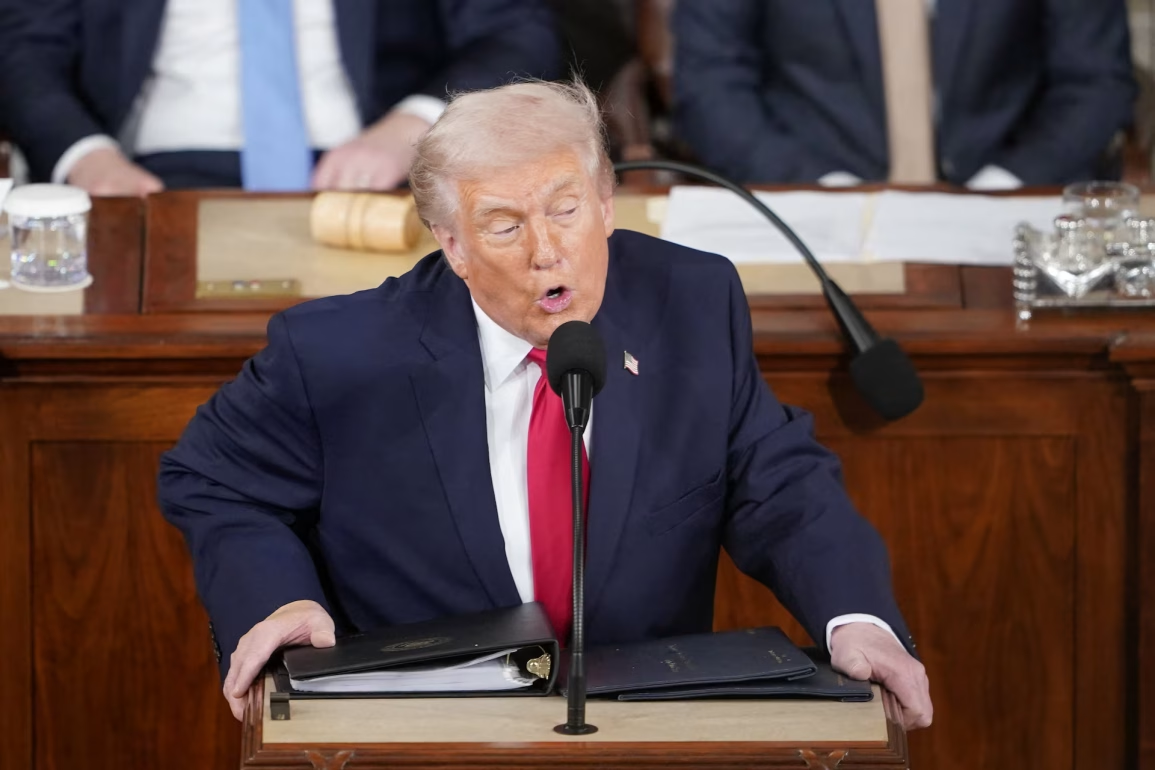
President Donald Trump delivered his first State of the Union address of his second term on February 24, 2026, speaking for nearly one hour and 47 minutes—the longest such speech on record. The address came at a challenging time for Trump: his approval ratings were low, the Supreme Court had recently struck down his major global tariffs, and tensions with Iran continued as he weighed possible further military action. Despite these issues, Trump used the speech to highlight his achievements, attack Democrats, and set the stage for the upcoming 2026 midterm elections.
One major focus was immigration, a topic Trump has often returned to during election years. He pointed to “angel moms” whose children were harmed by undocumented immigrants and warned that supporting Democrats would mean reopening the borders. He accused some in the room of allowing a “border invasion” and challenged Democrats to stand if they believed the government’s first duty is to protect American citizens over “illegal aliens.” Most Democrats stayed seated, prompting prolonged applause from Republicans and sharp words from Trump, who said they should be ashamed. A few Democrats, including Representatives Rashida Tlaib and Ilhan Omar, shouted protests during the speech. While immigration remains a stronger issue for Republicans in polls, Trump’s handling of it has faced criticism, especially after incidents involving federal agents.
On tariffs, Trump avoided directly attacking the Supreme Court again but claimed he still held strong leverage with other countries. He said Congress did not need to pass laws to make his tariffs permanent, even though the Constitution gives Congress authority over tariffs. He also made a bold prediction: tariffs paid by foreign countries could eventually replace much of the income tax system, easing the burden on Americans. This echoed early U.S. history when tariffs were a main revenue source, but experts doubt it could happen on a large scale today.
The speech included several moments of disruption from Democrats. Beyond Tlaib and Omar, Representative Al Green was removed from the chamber after displaying a sign protesting a racist video Trump had shared. Another Democrat called Trump a liar when he claimed to have ended eight wars. Some lawmakers walked out mid-speech, showing deep divisions.
Trump leaned into his showman style with dramatic elements. He honored the gold medal-winning U.S. men’s Olympic hockey team in the gallery and announced a Presidential Medal of Freedom for goaltender Connor Hellebuyck. He awarded military honors, including Medals of Honor to a 100-year-old Korean War veteran and another service member. He also arranged a family reunion for a political prisoner from Venezuela. Throughout, he pointed out when Democrats did or did not stand and applaud, joking that their rare standing ovation for the hockey team was a first.
Some topics were noticeably absent. Trump blamed Democrats for a Department of Homeland Security shutdown but skipped details about why—killings of two U.S. citizens by immigration agents in Minneapolis. He barely mentioned his deportation efforts, the released Epstein files (which his administration had touted for transparency), or detailed plans to address economic affordability, a major voter concern.
On Iran, Trump made a rare effort to justify potential future strikes. He accused Iran and its proxies of killing thousands of American troops with roadside bombs and killing around 32,000 protesters. He claimed his earlier strikes had wiped out Iran’s nuclear program, but said the regime was rebuilding it against warnings. He preferred a deal but vowed never to allow the “world’s number one sponsor of terror” to have nuclear weapons.
Trump raised concerns about the 2026 elections with an ominous warning about Democrats. He said they “want to cheat” because their policies are bad, and “we’re going to stop it.” He pushed for the “Save America Act” to require strict voter ID and stop noncitizens from voting. There is no evidence of widespread fraud in recent elections, and such claims have been repeatedly debunked.
Finally, the speech contained several false or exaggerated claims. Trump said he inherited record inflation (it was around 3% in early 2025, far from records), a wide-open border (crossings had already dropped under Biden), gas below $2.30 in some states (not accurate per averages), trillions in investment commitments (wildly overstated), and a “golden age” with the best economy ever (while job growth slowed in 2025 and unemployment rose slightly, though raw employment numbers are high due to population growth).
Overall, the address was heavy on patriotism, economic optimism, and partisan attacks, with little new policy detail. It aimed to rally Republicans and frame Democrats negatively ahead of midterms, even as Trump faces political headwinds.