
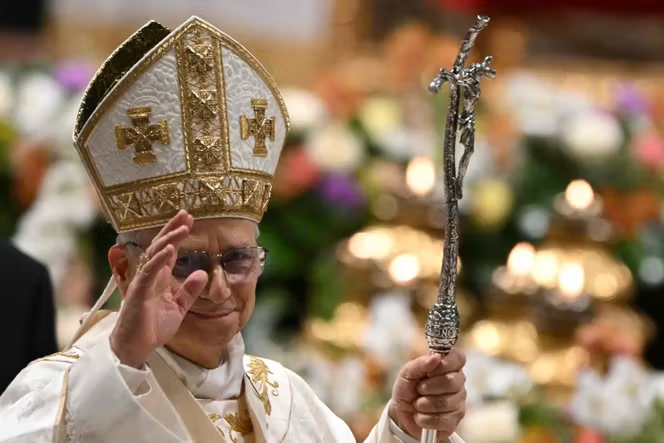
VATICAN CITY — Pope Leo XIV delivered his first Easter Mass as leader of the Roman Catholic Church on Sunday, using the occasion to urge the world to choose peace over war through dialogue and hope.
The 70-year-old pontiff, the first pope born in the United States, celebrated the resurrection of Jesus Christ while addressing ongoing violence in several parts of the world. Speaking from the balcony of St. Peter’s Basilica during the traditional Urbi et Orbi blessing, he called on people to lay down their weapons and seek genuine encounters with one another instead of domination.
“Let us allow our hearts to be transformed by his immense love for us! Let those who have weapons lay them down! Let those who have the power to unleash wars choose peace! Not a peace imposed by force, but through dialogue! Not with the desire to dominate others, but to encounter them!” the pope said.
Leo acknowledged a troubling indifference to the suffering caused by conflict, including the deaths of thousands of people and the economic and social damage that follows. He quoted his predecessor, Pope Francis, who had spoken last Easter about the “great thirst for death, for killing” seen around the world. Francis died the day after that appearance.
In a slight break from tradition, Leo did not list specific global conflicts by name in his blessing, even though he had done so during his Christmas message. No reason was given for the change.
Earlier in the day, about 50,000 people gathered in St. Peter’s Square for the outdoor Easter Mass. The altar was surrounded by white roses, and spring flowers lined the steps, creating a hopeful scene that matched the pope’s message of renewal and life after death. In his homily, Leo encouraged believers to hold onto hope despite the “violence of war that kills and destroys,” as well as other evils like the abuse of the weak and the exploitation of the earth for profit.
He also announced a special prayer vigil for peace to be held at the basilica on April 11.
Small Changes in Vatican Traditions
During Holy Week, Pope Leo brought back some customs that had changed under Pope Francis. He greeted the faithful in 10 languages, including Arabic, Chinese, and Latin—a practice Francis had stopped. After the blessing, Leo stepped out from the shadows of the loggia to wave at the cheering crowd and later rode the popemobile down Via della Conciliazione toward the Tiber River.
On Holy Thursday, he returned to the tradition of washing the feet of priests, rather than traveling to prisons or other places to include a wider group of people. On Good Friday, he carried the wooden cross for all 14 stations of the Way of the Cross, becoming the first pope in decades to do so fully.
Subdued Celebrations in the Holy Land
In Jerusalem, Easter ceremonies at the Church of the Holy Sepulchre—the traditional site of Jesus’ crucifixion and resurrection—were scaled back due to security concerns. Israeli authorities limited public gatherings because of ongoing missile threats. Similar restrictions affected the recent Muslim observances of Ramadan and Eid al-Fitr, as well as the Jewish Passover holiday. The annual priestly blessing at the Western Wall, which usually draws tens of thousands, was limited to just 50 people this year. These rules have created tension between Israeli officials and Christian leaders.
Joy in Gaza After Ceasefire
In Gaza City, the small Palestinian Christian community celebrated what many described as a more hopeful Easter. At the Holy Family church, Catholics of all ages attended Mass, singing and lining up to kiss an image of Jesus. George Anton, a local resident, said there was “great joy” after nearly three years of suffering and missed holidays. “People are somewhat relieved and more stable,” he added, following the recent ceasefire tied to President Donald Trump’s 20-point plan aimed at ending Hamas rule and rebuilding the territory.
Maintaining Normalcy in Tehran
In Iran’s capital of Tehran, Armenian Christians gathered at St. Sarkis Cathedral to mark Easter, trying to create a sense of normal life even as the U.S.-Israeli war with Iran entered its second month. Families hugged and children traded painted eggs despite daily airstrikes on the city since the conflict began on February 28.
“Whether we like it or not, we have young children who do not understand what’s going on,” said Juanita Arakel, a 40-year-old English teacher. “They just need to feel normal.”
Iran is home to about 300,000 Christians, mostly Armenians, who have reserved seats in parliament. Archbishop Sepuh Sargsyan of the Armenian Diocese of Tehran repeated the community’s prayer: “Our calls and prayers are that we will be able to end this war.”
Across these divided regions, Easter Sunday served as a reminder of resurrection and hope, even as Pope Leo XIV and local Christians called for an end to the violence through dialogue and human connection.