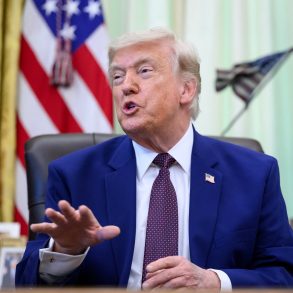
President Donald Trump has filed a massive $10 billion lawsuit against the British Broadcasting Corporation (BBC), accusing the public broadcaster of defaming him by deceptively editing his January 6, 2021, speech in a documentary. The suit, filed on December 15, 2025, in federal court in Miami, Florida, claims the BBC intentionally spliced together parts of the speech to falsely portray Trump as directly calling for violence ahead of the Capitol riot.
The controversy stems from a 2024 episode of the BBC’s investigative program Panorama, titled “Trump: A Second Chance?” The documentary aired in the UK shortly before the 2024 U.S. presidential election. In the original speech, delivered to supporters in Washington, D.C., Trump said early on: “We’re going to walk down to the Capitol, and we’re going to cheer on our brave senators and congressmen and women.” More than 50 minutes later, he added: “We fight. We fight like hell.” He also urged the crowd to protest “peacefully and patriotically” in parts that were omitted.
However, the Panorama edit combined these segments to make it appear as a single quote: “We’re going to walk down to the Capitol… and I’ll be there with you. And we fight. We fight like hell.” This created the impression, according to critics, that Trump was explicitly encouraging supporters to march with him and engage in violent action.
Trump’s legal team argues that the editing was “intentional, malicious, and deceptive,” aimed at interfering in the 2024 election and advancing a “leftist political agenda.” The complaint seeks $5 billion for defamation and another $5 billion for violating Florida’s Deceptive and Unfair Trade Practices Act. A spokesperson for Trump’s lawyers called it a “brazen attempt” to sway the election, adding that the suit holds the BBC accountable “just as he has held other fake news mainstream media responsible.”
The BBC has acknowledged the edit was an “error of judgment” that gave a “mistaken impression” of a direct call for violence. The broadcaster apologized to Trump and removed the episode from its platforms, but it has firmly rejected any basis for a defamation claim. In response to the lawsuit, a BBC spokesperson stated: “We will be defending this case” and declined further comment on ongoing proceedings.
The scandal escalated earlier when a leaked internal memo criticized the BBC’s handling of the clip, contributing to broader accusations of bias in coverage of Trump and other issues. This led to the resignations in November 2025 of BBC Director-General Tim Davie and Head of News Deborah Turness. BBC Chairman Samir Shah described the edit as regrettable but maintained it did not reflect systemic malice.
Trump filed the case in Florida, citing the BBC’s business activities in the state, including its website, an office in Coral Gables, and partnerships like the streaming service BritBox, which carries BBC content in the U.S. The lawsuit also notes that Americans could access the documentary via VPNs or third-party distributors. Although the program never aired on U.S. television and BBC iPlayer is geo-restricted to the UK, Trump’s team argues these avenues establish jurisdiction.
This lawsuit marks an international expansion of Trump’s ongoing battles with media outlets. Since his 2024 reelection, he has secured settlements from U.S. companies, including $15 million from ABC (owned by Disney) over comments by anchor George Stephanopoulos and $16 million from Paramount (parent of CBS) over edited footage of an interview with Kamala Harris. He has other pending suits against outlets like The New York Times and The Wall Street Journal.
Legal experts note significant hurdles for Trump’s case. In the U.S., public figures like the president must prove “actual malice”—that the BBC knew the edit was false or acted with reckless disregard for the truth. The BBC’s apology and admission of error could undermine claims of intent, and Trump’s reelection shortly after the documentary aired may weaken arguments of reputational harm. Press freedom advocates, such as Seth Stern from the Freedom of the Press Foundation, called the $10 billion demand “preposterous,” pointing out Trump won the election, suffered no financial loss, and has even pardoned many January 6 participants while downplaying the riot’s severity.
In the UK, politicians across parties have rallied behind the BBC. Prime Minister Keir Starmer’s spokesperson emphasized defending “a strong, independent BBC” that reports “without fear or favour,” while stressing the importance of correcting mistakes. Opposition figures, including Liberal Democrat leader Sir Ed Davey, urged Starmer to protect the broadcaster from what they called an “outrageous legal threat.”
As the case proceeds, it highlights tensions over media accountability, editorial standards, and cross-border defamation claims in an era of polarized politics. The BBC, funded largely by UK license fees, has vowed to fight vigorously, potentially setting a precedent for how foreign broadcasters handle U.S. legal challenges.