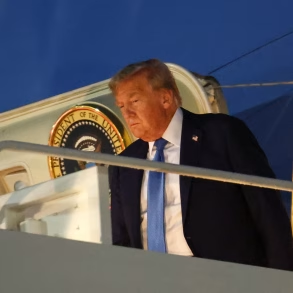


President Donald Trump’s administration has launched a new initiative called the “Board of Peace” to oversee the reconstruction and stabilization of Gaza following a ceasefire that ended two years of intense conflict between Israel and Hamas. The board, chaired by Trump himself, requires a $1 billion payment from countries or entities seeking permanent membership, according to U.S. officials and reports from multiple news outlets.
The idea emerged as part of a broader U.S.-backed plan endorsed by the United Nations Security Council. This plan aims to demilitarize Gaza, disarm Hamas, deploy an international security force, and rebuild the territory, which has suffered massive destruction—about 80 percent of buildings damaged or ruined, leaving millions displaced in tent camps amid rubble.
To join the Board of Peace, countries receive an invitation to serve a three-year term with no financial requirement. However, paying $1 billion in cash within the first year of the board’s charter secures a permanent seat. U.S. officials emphasize that all funds raised will directly support Gaza’s rebuilding efforts, with promises of no high salaries or excessive bureaucracy, unlike some traditional international organizations.
Trump has described the board as “the Greatest and Most Prestigious Board ever assembled” and positioned it as a bold new way to resolve global conflicts, potentially extending beyond Gaza. In invitation letters to world leaders, he highlighted it as an alternative to stalled UN mechanisms, noting U.S. vetoes in the Security Council and funding cuts that weakened the world body.
The board’s executive committee includes high-profile figures such as U.S. Secretary of State Marco Rubio, Trump’s son-in-law Jared Kushner, foreign policy envoy Steve Witkoff, deputy national security adviser Robert Gabriel, former British Prime Minister Tony Blair, World Bank President Ajay Banga, and billionaire businessman Marc Rowan. An Israeli businessman, Yakir Gabay, is also part of it.
Day-to-day governance in Gaza falls to a Palestinian technocratic committee, while a separate Gaza executive board— involving representatives from countries like Turkey, Qatar, Egypt, and the United Arab Emirates—supports those efforts. Notably, the Palestinian Authority, which governs parts of the West Bank and is seen as a future administrator of Gaza after reforms, has no direct representative on the main Board of Peace.
Several nations have confirmed receiving invitations, with some accepting. Hungary and Vietnam have said yes, while others like India, Australia, Jordan, Greece, Cyprus, Pakistan, Canada, Paraguay, Argentina, and Albania are considering or discussing the offer. The full membership list is expected to be announced soon, possibly at the World Economic Forum in Davos.
The plan has drawn criticism. Israeli Prime Minister Benjamin Netanyahu stated that the board was not coordinated with Israel and contradicts its policies, particularly objecting to roles for Turkey and Qatar—countries Israel accuses of supporting Hamas. Israel has long sought to exclude those nations from Gaza’s future governance.
As the ceasefire, effective since October 10, 2025, enters its second phase, the Board of Peace represents an ambitious—and controversial—American-led approach to post-conflict reconstruction in Gaza, blending diplomacy, funding incentives, and a promise of efficient aid delivery.