

Senate Democrats are threatening to block funding for the Department of Homeland Security (DHS) in response to a recent fatal shooting in Minneapolis, raising the risk of a partial government shutdown by the end of January 2026.
The controversy stems from two high-profile incidents in Minneapolis this month. On January 7, 2026, an Immigration and Customs Enforcement (ICE) agent fatally shot Renée Good, a 37-year-old American citizen. Then, on January 24, a federal officer—reportedly a Border Patrol agent—shot and killed Alex Pretti, also 37, an intensive care unit nurse working for the Department of Veterans Affairs. Video evidence and witness accounts in both cases have fueled public outrage, with critics arguing the shootings were unjustified and highlight abuses in federal immigration enforcement under the Trump administration.
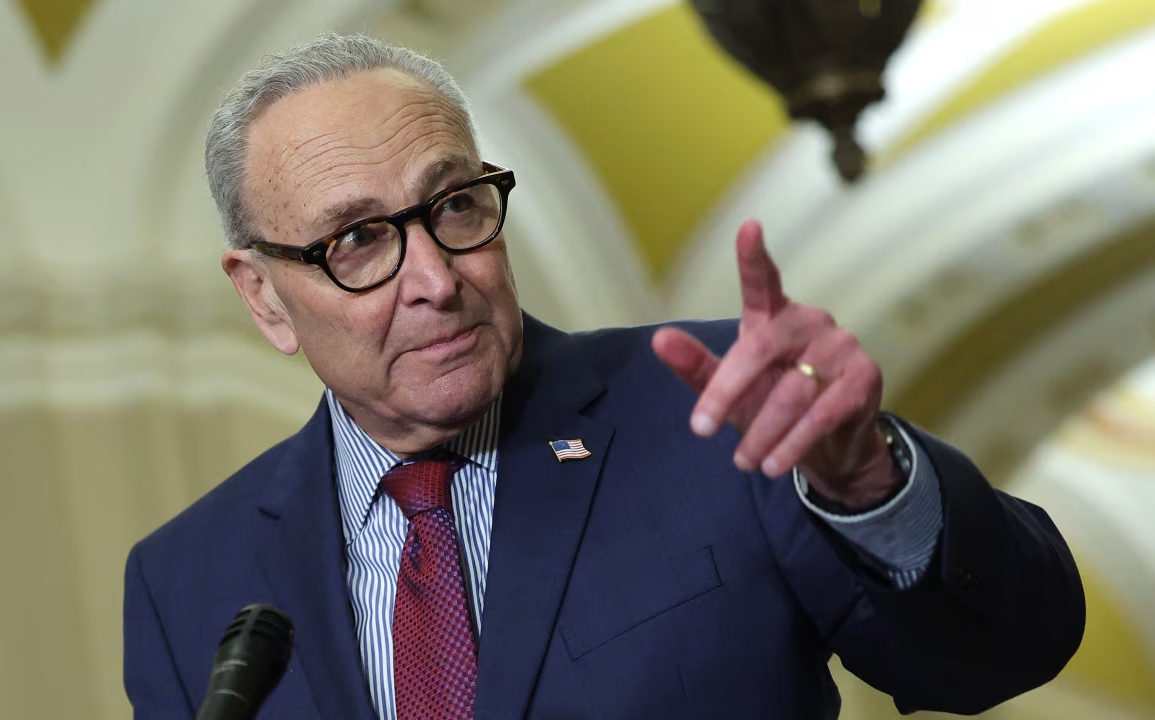
Senate Democratic Leader Chuck Schumer quickly condemned the latest shooting as “appalling.” In a statement and social media post, he announced that Senate Democrats would not support a spending package that includes DHS funding. Schumer argued that the bill lacks “common sense reforms” to address ICE abuses, blaming Republicans for refusing to challenge President Trump. “I will vote no,” he declared.
Other Democrats echoed this position. Senators like Catherine Cortez Masto and Jacky Rosen of Nevada—both considered moderates who had supported Republicans in past funding votes—said they would oppose the DHS portion. Hawaii Sen. Brian Schatz, Minnesota Sens. Amy Klobuchar and Tina Smith, Washington Sen. Patty Murray (the top Democrat on the Senate Appropriations Committee), and others also vowed to vote against it. Murray wrote on X that federal agents “cannot murder people in broad daylight and face zero consequences.”
The funding situation is complicated. Congress has already passed and President Trump signed several of the 12 annual spending bills for the fiscal year. Six more bills, bundled together, cover agencies including DHS. These must pass by midnight Friday, January 30, 2026, or funding for those agencies will lapse, leading to a partial shutdown. Much of the government—including Defense, Justice, Agriculture (which funds food assistance), and others—would continue operating under prior funding measures.
Republicans need at least some Democratic votes to pass the package in the Senate, where a simple majority is required but procedural hurdles exist. House Democrats had already largely rejected the DHS funding last week, with many calling for the impeachment of DHS Secretary Kristi Noem amid growing fury over the immigration crackdown and the Minneapolis incidents.
Democrats are pushing for specific changes to the DHS bill, such as requiring ICE agents to obtain warrants for arrests, improving training, mandating that agents identify themselves, and keeping Border Patrol focused on the border rather than interior raids. Without these reforms, they say they won’t support funding what they view as an out-of-control agency.
Some Republicans have called for thorough investigations into the shootings. Sen. Bill Cassidy (R-La.) said the credibility of ICE and DHS is at stake and urged a joint federal-state probe. Sen. Thom Tillis (R-N.C.) pushed for an “impartial investigation,” warning against rushing to judgment. However, others like Sen. Lindsey Graham (R-S.C.) urged Democrats to back off and focus on issues like sanctuary cities instead of defunding border protection.
The White House and Republicans have reached out to Democrats for talks, but no major concessions have emerged. Democrats held conference calls over the weekend, including one with Minnesota Gov. Tim Walz and Attorney General Keith Ellison, to plan next steps.
The Senate isn’t scheduled to return until Tuesday due to a snowstorm, and the House is out for the week, adding to the uncertainty. If changes are made, the House would need to vote again.
Schumer suggested Republicans split the package—pass the other five bills quickly and rewrite the DHS one separately. “This is the best course of action, and the American people are on our side,” he said.
As the deadline approaches, the standoff highlights deep divisions over immigration enforcement, with Democrats using the funding fight to demand accountability and Republicans defending national security priorities. A partial shutdown could disrupt DHS operations, though essential functions like border security might continue in limited form.