

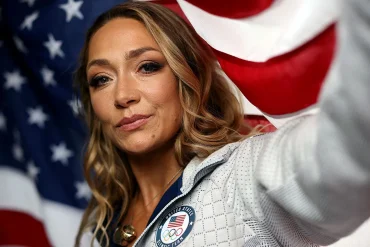
The International Bobsleigh and Skeleton Federation (IBSF) has concluded that Team Canada intentionally manipulated a key qualifying event, costing U.S. skeleton athlete Katie Uhlaender her chance to compete in the upcoming Milan Cortina 2026 Winter Olympics.
Uhlaender, a five-time Olympian hoping to become the first woman to represent the United States in six Winter Games, was denied qualification due to actions taken at the North American Cup in Lake Placid, New York, earlier this month. The controversy centers on Team Canada’s last-minute withdrawal of four athletes from the women’s skeleton competition.
Under IBSF rules, the number of points awarded in a race depends on the size of the field. With fewer than 21 competitors, points are reduced by 25%. Originally, enough athletes were entered to award full points, but after Canada’s withdrawals, the field dropped to 19 sliders. This cut the maximum points available, making it mathematically impossible for Uhlaender—even after she won the race—to earn the points needed to qualify.
The IBSF investigation found that “the action of the Canadians was intentional and directed to reducing the points available to athletes who slid at the final Lake Placid NAC.” The federation stated there was “substantial evidence” supporting Uhlaender’s claim that the withdrawals were a deliberate effort by Canada to protect its own Olympic quota spots. One Canadian athlete, Madeline Parra, told The Canadian Press that coaches explained the move was in the “best interest for the way points had worked” to help secure two Olympic spots for their team.
Bobsleigh Canada Skeleton initially defended the decision, saying it was made after evaluating athlete health, safety, long-term development, and in consultation with the IBSF. They claimed continuing to race the athletes was not in their or the program’s best interests. However, the IBSF’s findings contradicted this explanation, pointing to evidence of intent to limit points for others.
Despite the manipulation ruling, the IBSF has not imposed penalties on Canada, changed the event results, or altered Uhlaender’s standings. The federation explained that Olympic rules do not allow for changing event records outside of formal sanctions.
Uhlaender responded strongly to the announcement. “Today’s decision by the International Bobsleigh and Skeleton Federation (IBSF) Appeals Tribunal reinforces what I, and many other athletes, have known all along,” she said in a statement. “The actions of Canadian coach Joe Cecchini and Bobsleigh Canada Skeleton were intentional and deliberately aimed at reducing the points available. This was blatant competition manipulation, yet there have been no consequences for the coach involved.”
She emphasized her fight goes beyond her own case: “I am fighting for what is right. I am fighting for my rightful Olympic opportunity. But more importantly, I am fighting for every athlete who has been harmed by competition manipulation. I am far from the only athlete affected by these actions.”
Uhlaender continues to push for a spot at the Milan Cortina Games, set for February 6-22, 2026. The U.S. Olympic and Paralympic Committee (USOPC) has petitioned the International Olympic Committee (IOC) to grant her a wildcard entry. Fourteen other countries have joined the effort, with national Olympic committees from Malta, Israel, the Virgin Islands, South Korea, Belgium, Brazil, Jamaica, Denmark, Netherlands, Ghana, Nigeria, Trinidad, Colombia, and Latvia signing letters of support.
The IOC responded that the issue falls under IBSF rules for an IBSF-organized event and noted the federation has already addressed Uhlaender’s concerns.
Uhlaender expressed gratitude for the international backing. “The support I have received from the international bobsleigh and skeleton community has been overwhelming,” she said. “That support has given me the strength to keep pushing forward, for integrity, accountability, and a sport that truly upholds the values that brought us together to compete.”
She plans to pursue the matter further with legal counsel, potentially at the Court of Arbitration for Sport. Uhlaender also called on U.S. Vice President JD Vance, who will lead the American delegation to the Games, to advocate for her during meetings with IOC leadership, including President Kirsty Coventry. She urged that granting a wildcard would uphold fairness, protect competition integrity, and inspire young athletes to stand up for ethics.
The case highlights ongoing debates about fairness in Olympic qualification, athlete welfare, and the need for stronger rules to prevent strategic manipulation in high-stakes events. As the Milan Cortina Olympics approach, Uhlaender’s fight underscores the passion and principles that drive competitors in skeleton and beyond.