

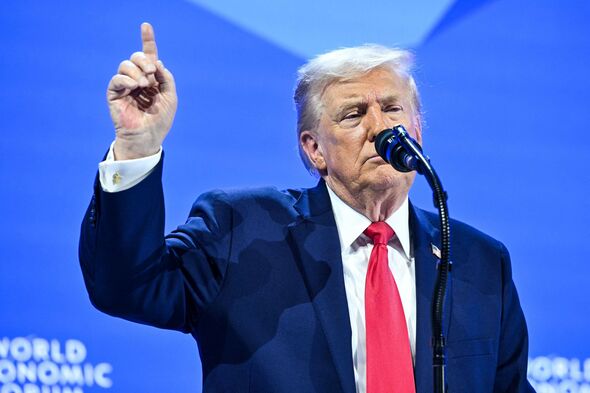
President Donald Trump announced on January 21, 2026, that he had reached a “framework of a future deal” regarding Greenland and the broader Arctic region during talks with NATO Secretary General Mark Rutte at the World Economic Forum in Davos, Switzerland. This development led Trump to immediately cancel planned punitive tariffs on several European countries, marking a significant de-escalation in a heated controversy that had strained relations within the NATO alliance.
The dispute began when Trump repeatedly expressed interest in acquiring Greenland, a self-governing territory of Denmark. He argued that U.S. control or strong influence over the island was essential for national security, particularly to counter potential threats from Russia and China in the Arctic. In recent weeks, the Trump administration floated ideas of purchasing the territory outright or even using military force if necessary, though Trump later explicitly ruled out force during his Davos speech, calling instead for “immediate negotiations.”
Tensions escalated when Trump threatened to impose tariffs starting at 10% on February 1 (rising to 25% in June) on goods from eight European nations—including Denmark, Germany, Norway, Sweden, France, the UK, the Netherlands, and Finland—if they did not support a deal for the U.S. to gain “complete and total” control of Greenland. These threats followed Europe’s firm stance that Greenland is not for sale and remains under Danish sovereignty.
In a post on Truth Social, Trump wrote: “Based upon a very productive meeting that I have had with the Secretary General of NATO, Mark Rutte, we have formed the framework of a future deal with respect to Greenland and, in fact, the entire Arctic Region. This solution, if consummated, will be a great one for the United States of America, and all NATO Nations. Based upon this understanding, I will not be imposing the Tariffs that were scheduled to go into effect on February 1st.”
Trump described the framework as a “concept of a deal” in a subsequent CNBC interview with Joe Kernen, calling it “a little bit complex” and promising more details later. He suggested it could involve U.S. access to mineral rights in Greenland, participation in his proposed “Golden Dome” missile defense system, and broader cooperation to secure the Arctic against Russian and Chinese influence. Trump emphasized that the arrangement would be long-term—”forever”—and beneficial for everyone, including NATO allies.
The announcement triggered an immediate positive reaction in financial markets, with stocks rising as investors welcomed the reduced risk of a transatlantic trade conflict.
European responses were mixed but generally cautious. Danish Foreign Minister Lars Løkke Rasmussen noted that the day “ended on a better note than it began,” praising Trump’s decision to forgo tariffs and rule out force, while stressing the need to address U.S. Arctic security concerns while respecting Denmark’s “red lines” and sovereignty. Dutch Prime Minister Dick Schoof called it a step toward “de-escalation.” Italian Prime Minister Giorgia Meloni welcomed the tariff suspension but urged continued dialogue among allies.
However, Germany’s Finance Minister Lars Klingbeil warned against premature optimism, saying, “We have to wait a bit and not get our hopes up too soon,” and reaffirmed that Greenland’s sovereignty could not be compromised. NATO officials, including a spokeswoman for Rutte, described the talks as “very productive” and focused on collective Arctic security through NATO’s Arctic allies, with future negotiations involving Denmark, Greenland, and the U.S. to prevent Russian or Chinese footholds.
The framework appears to fall short of Trump’s earlier demands for full U.S. ownership, possibly centering instead on expanded military presence (such as bases or updated agreements from the 1951 U.S.-Denmark defense pact), resource access, and joint defense efforts. Details remain vague, with the White House and NATO indicating more information will emerge as discussions continue.
This twist represents a notable shift from confrontation to negotiation in U.S.-Europe relations over Greenland, though underlying questions about the island’s future and NATO unity persist amid ongoing global security challenges in the Arctic.