

Global financial markets are experiencing heightened uncertainty as the European Parliament prepares to suspend its approval of a major trade agreement with the United States. This decision comes in direct response to escalating tensions over President Donald Trump’s aggressive push to acquire Greenland, including threats of new tariffs on several European countries.
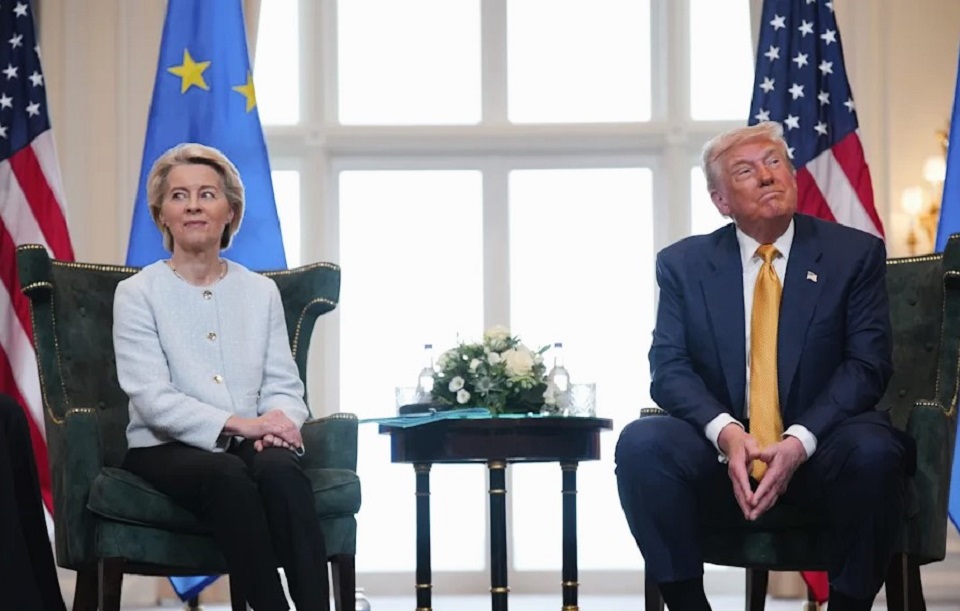
The trade deal, finalized in July at Trump’s Turnberry golf course in Scotland, had aimed to ease previous trade frictions. It reduced U.S. tariffs on most European goods to 15% (from an initial threat of 30% under Trump’s “Liberation Day” tariffs in April) in exchange for European investments in the U.S. and policy changes to boost American exports. The agreement still required final approval from the European Parliament to take effect.
However, Trump’s weekend announcement reignited the conflict. He threatened to impose 10% tariffs on goods from eight European nations—Denmark, Norway, Sweden, France, Germany, the United Kingdom, the Netherlands, and Finland—starting February 1. These tariffs would rise to 25% on June 1 unless a deal is reached for the U.S. to purchase Greenland, the mineral-rich Arctic island that is a semi-autonomous territory of Denmark. Trump has framed the acquisition as essential for U.S. strategic interests in the Arctic, citing concerns over Chinese and Russian influence.
European leaders have strongly rejected the idea of selling Greenland, viewing the tariff threats as coercive and an attack on sovereignty. Influential figures like Manfred Weber, head of the European People’s Party, stated that approval of the trade deal is “not possible at this stage.” Bernd Lange, chair of the European Parliament’s international trade committee, emphasized that the U.S. actions undermine the stability of EU-U.S. relations. The suspension is expected to be formally announced in Strasbourg on Wednesday, halting progress on the deal’s legislative proposals.
The standoff has rattled investors. U.S. stocks fell sharply on Tuesday, with the Dow Jones dropping more than 1.7%, the S&P 500 declining over 2%, and the Nasdaq closing about 2.4% lower. European markets saw continued losses, while Asia-Pacific indexes were mixed. As a safe-haven asset, gold surged to a new record above $4,800 per ounce, reflecting investor flight to stability amid geopolitical risks. Silver also approached recent highs, though it dipped slightly from its peak.
Currency markets showed the U.S. dollar holding steady after a modest overnight decline. The broader concern is the potential for a renewed transatlantic trade war. Before the July deal, the EU had prepared retaliatory tariffs on up to €93 billion ($109 billion) worth of U.S. goods in response to earlier U.S. measures, but those were paused during negotiations. That reprieve ends in early February, raising the possibility of EU levies resuming unless extended or resolved.
French President Emmanuel Macron has called the U.S. approach “fundamentally unacceptable,” especially when tariffs are used to pressure allies on territorial issues. He and others have urged consideration of the EU’s “anti-coercion instrument”—a powerful, untested tool dubbed the “trade bazooka.” This could restrict U.S. companies’ access to EU markets, impose export/import limits, or curb foreign investment in the bloc.
U.S. officials, including Treasury Secretary Scott Bessent, have urged Europe against retaliation, warning of unpredictable consequences. Commerce Secretary Howard Lutnick and U.S. Trade Representative Jamieson Greer have signaled that any EU countermeasures would face a strong U.S. response.
The U.S. and EU are each other’s largest trading partners, with over €1.6 trillion ($1.9 trillion) in goods and services exchanged in 2024—nearly a third of global trade. A full breakdown could disrupt supply chains and raise costs on both sides.
The situation remains fluid, with opportunities for dialogue at the World Economic Forum in Davos, where Trump is scheduled to speak. European leaders hope for de-escalation, but analysts warn of months of uncertainty if the Greenland dispute persists. Economists note that while last year’s tariff battles had limited immediate impact, renewed confrontation could slow growth and heighten volatility in 2026.
This developing story highlights the fragile balance between economic cooperation and geopolitical ambitions among longtime allies. Markets will watch closely for any signs of compromise—or further escalation.