

President Donald Trump has escalated his long-standing push to acquire Greenland by announcing new tariffs on several European countries unless Denmark agrees to sell the massive Arctic island to the United States.
In a detailed post on Truth Social on Saturday, January 17, 2026, Trump declared that the U.S. would impose a 10% tariff on all goods imported from Denmark, Norway, Sweden, France, Germany, the United Kingdom, the Netherlands, and Finland, starting February 1, 2026. He stated that the tariff would rise to 25% on June 1 if no deal is reached for the “complete and total purchase” of Greenland. Trump framed the move as a response to what he called decades of U.S. subsidies to these nations through low or no tariffs and military protection, while insisting that Greenland’s control is vital for American and global security.
Trump argued that the U.S. has tried to buy Greenland for more than 150 years but has been repeatedly turned down by Denmark. He claimed that both China and Russia are interested in the territory, describing Denmark’s defenses there as inadequate—jokingly referring to them as “two dogsleds as protection, one added recently.” He emphasized that only the United States, under his leadership, can secure the island properly. Trump also linked Greenland to advanced U.S. defense systems, including the “Golden Dome” missile defense program, saying it is essential for maximum efficiency and the protection of the planet.
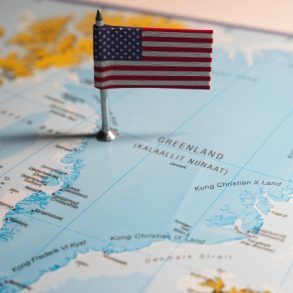
Greenland, the world’s largest island, is a semi-autonomous territory of Denmark. It holds strategic importance in the Arctic due to its location, melting ice that opens new shipping routes, vast natural resources, and the presence of a key U.S. military base. Trump has repeatedly highlighted these factors, warning that foreign powers could exploit the area if it remains under Danish control.
The announcement drew immediate backlash from European leaders and sparked protests. Demonstrators in Copenhagen and Greenland’s capital, Nuuk, rallied against the threats, chanting slogans like “Greenland is not for sale” and waving Greenland’s flag while marching to the U.S. embassy. European officials, including those from the targeted countries, condemned the tariffs as unacceptable pressure on a NATO ally. Leaders like French President Emmanuel Macron and British officials stressed that Greenland’s future should be decided by Denmark and its people, not through intimidation. They warned that such actions could damage the NATO alliance, which relies on collective defense among members.
In the U.S., reactions were mixed. Some Republican figures supported Trump’s view that Greenland is crucial for national security, while bipartisan lawmakers visited Copenhagen recently to reaffirm ties with Denmark and highlight the importance of alliances in an unstable world.
Trump’s post ended with an offer to negotiate, saying the U.S. remains “immediately open” to talks with Denmark and the other countries involved. However, the move comes amid ongoing legal questions about the president’s tariff powers, including a pending Supreme Court ruling on earlier tariffs imposed in 2025.
This developing situation highlights growing tensions between the U.S. and its European allies over Arctic influence and trade policy.