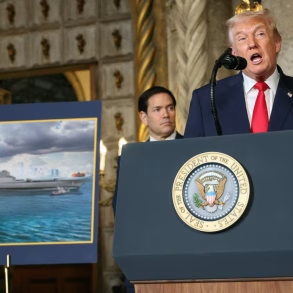
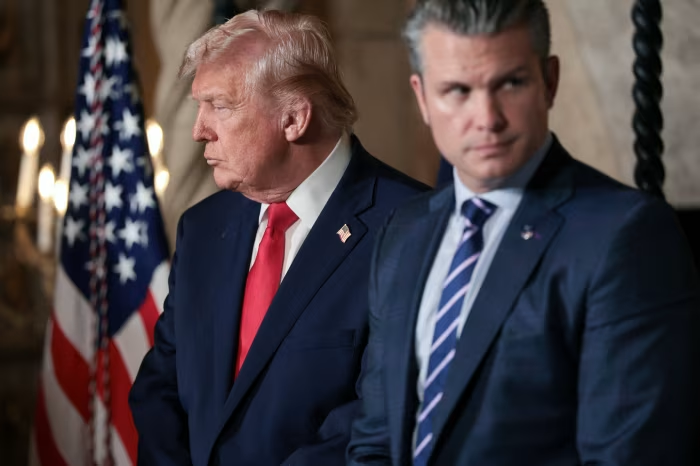
President Donald Trump revealed on Monday that the United States had carried out a strike on a dock facility in Venezuela, describing it as a site where drugs were loaded onto boats for smuggling. Speaking to reporters at his Mar-a-Lago resort in Florida while hosting Israeli Prime Minister Benjamin Netanyahu, Trump said there had been a “major explosion in the dock area where they load the boats up with drugs.” He added, “We hit all the boats, and now we hit the area. It’s the implementation area… and that is no longer around.”
Trump declined to specify whether the operation was conducted by the U.S. military or the CIA, stating only that it occurred “along the shore.” When pressed on details, he responded, “It doesn’t matter,” emphasizing the destruction of the facility.
This announcement marks what appears to be the first known U.S. attack on a land-based target in Venezuela since the Trump administration launched its intensified pressure campaign against the country four months ago. The campaign began with strikes on suspected drug-smuggling vessels in international waters and has since expanded.
Trump first hinted at the strike during a radio interview on Friday with WABC’s “Cats and Cosby” show, where he said the U.S. had “knocked out” a “big facility” tied to drug trafficking. Reports from sources familiar with the matter, including CNN and The New York Times, suggest the operation may have been a CIA drone strike on a remote coastal port facility, possibly linked to the Venezuelan gang Tren de Aragua.
Neither the White House, Pentagon, nor CIA has provided official confirmation or details. The Pentagon referred inquiries to the White House, and Venezuelan officials have not commented. There are no independent reports of an explosion or damage in Venezuela matching Trump’s description.
The strike comes amid a broader U.S. military buildup in the region, including over 15,000 troops, warships, and fighter jets positioned in the Caribbean. The administration has also imposed a blockade on sanctioned Venezuelan oil tankers, seizing several vessels to disrupt the government’s revenue.
Since early September, U.S. forces have conducted at least 30 strikes on alleged drug boats in the Caribbean Sea and eastern Pacific Ocean, killing more than 107 people according to administration figures. On Monday, the U.S. Southern Command announced another such strike in the Pacific, killing two individuals described as “narco-terrorists.”
Trump has framed these actions as part of an “armed conflict” with drug cartels to curb narcotics flowing into the United States. He has repeatedly pressured Venezuelan President Nicolás Maduro to step down, warning last week that it would be “smart” for him to do so and threatening tougher consequences if he resists.
Maduro’s government denies any role in drug trafficking, accusing the U.S. of using the campaign as a pretext to overthrow him and seize Venezuela’s vast oil reserves—the largest in the world.
Legal experts and human rights groups have criticized the strikes as potentially illegal under U.S. and international law, labeling them extrajudicial killings since they target individuals not posing an immediate threat.
The escalation raises questions about further U.S. actions in the region and potential responses from Venezuela or its allies. For now, the dock strike remains unverified beyond Trump’s statements, highlighting the opaque nature of the ongoing operations.