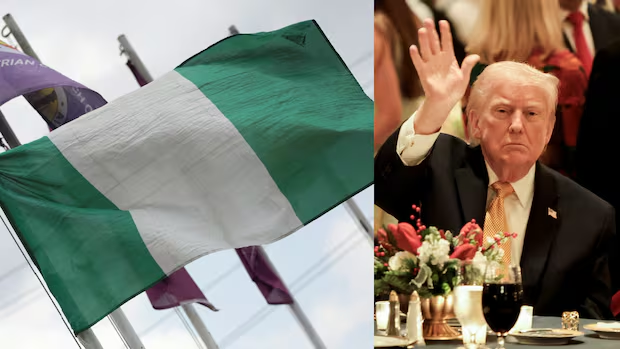
On Christmas Day 2025, President Donald Trump announced that the United States had carried out a powerful airstrike against ISIS fighters in northwest Nigeria. The attack, which Trump described as a “deadly strike,” targeted terrorists he accused of viciously killing innocent Christians. This military action comes after months of warnings from Trump about violence against Christians in Nigeria, raising questions about U.S. involvement in African conflicts.
The Strike: What Happened?
The U.S. military, working with Nigerian authorities, launched the operation in Sokoto State, a region in northwest Nigeria near the border with Niger. According to the U.S. Africa Command (AFRICOM), more than a dozen Tomahawk cruise missiles were fired from a Navy ship in the area. A short video released by the Pentagon showed the missiles launching, and AFRICOM confirmed that “multiple ISIS terrorists” were killed.
Residents in nearby villages like Jabo described a terrifying scene. “As it approached our area, the heat became intense,” said Abubakar Sani, a local resident. “Our rooms began to shake, and then fire broke out.” Another farmer, Sanusi Madabo, said the night sky glowed red, making it look almost like daytime. Luckily, no civilian casualties were reported, and social media images showed only missile fragments scattered outside a village.
Nigerian officials quickly confirmed their role in the strike. Foreign Minister Yusuf Tuggar said the government provided intelligence and gave the go-ahead after talks with U.S. Secretary of State Marco Rubio. President Bola Tinubu’s administration emphasized that the attack was about fighting terrorism, not targeting any religion. “Nigeria is a multi-religious country, and we’re working with partners like the US to fight terrorism and protect lives,” Tuggar told local TV.
Trump’s Warnings and the Bigger Picture
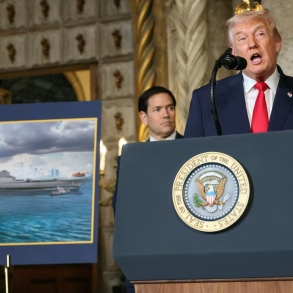
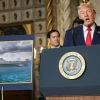
Trump made the announcement from his Mar-a-Lago estate in Florida, posting on his Truth Social platform: “Tonight, at my direction… the United States launched a powerful and deadly strike against ISIS Terrorist Scum in Northwest Nigeria.” He added a holiday twist: “MERRY CHRISTMAS to all, including the dead Terrorists, of which there will be many more if their slaughter of Christians continues.”
This wasn’t Trump’s first warning. Back in November, he threatened to cut off U.S. aid to Nigeria and send troops “guns-a-blazing” if the killings didn’t stop. He called it a “genocide” against Christians, a claim that echoes concerns from his first term. In October, his administration labeled Nigeria a “country of particular concern” for religious freedom issues.
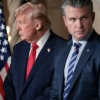
Defense Secretary Pete Hegseth praised the cooperation and hinted at more strikes ahead: “Grateful for Nigerian government support… more to come.” The attack fits into Trump’s strategy to protect Christian communities, which appeals to his evangelical supporters. Analysts say it comes at a time when the U.S. is shifting focus away from Africa to other regions, like the Western Hemisphere.
Nigeria’s Response and the Reality on the Ground
Nigeria’s government welcomed the help but pushed back on Trump’s religious framing. Minister Tuggar told CNN that violence in Nigeria isn’t just Muslims attacking Christians—it’s a complex regional conflict affecting everyone. “When you try to reduce it to just say, ‘Oh, no, it’s Muslims killing Christians in Nigeria,’ you see how you can get it completely wrong,” he said.
Experts agree. Nigeria, with over 230 million people, is split roughly between a Muslim north and Christian south. Groups like Boko Haram and ISIS have caused widespread violence, but most victims are actually Muslim. In Sokoto State, where the strike happened, the population is mostly Muslim, and attacks on Christians are rare. Al Jazeera reporter Ahmed Idris noted, “Sokoto State is probably the last place many Nigerians would think [Christian genocide] is happening.”
The violence stems from banditry, kidnappings, and extremism in the Sahel region, which includes Nigeria, Niger, and Mali. Without strong international support, these groups have grown stronger. U.S. airstrikes have helped in the past, but they sometimes hit the wrong targets based on bad intelligence, leading to civilian deaths.
What This Means Moving Forward
This strike shows growing U.S.-Nigeria teamwork against terrorism, but it also highlights tensions. Trump has accused Nigeria of not doing enough to protect Christians, while Nigerian leaders say their efforts are being ignored. Some experts worry airstrikes alone won’t solve the problem. “There is very little evidence that targeted airstrikes reduce armed group activity,” said Aneliese Bernard, a West Africa consultant.
As Trump settles into his second term, this action could lead to more U.S. involvement—or pullback—in Africa. For now, it brings a moment of holiday relief for some, but the fight against extremism in Nigeria is far from over. As one Nigerian official put it, the goal is to protect all innocent lives, no matter their faith.